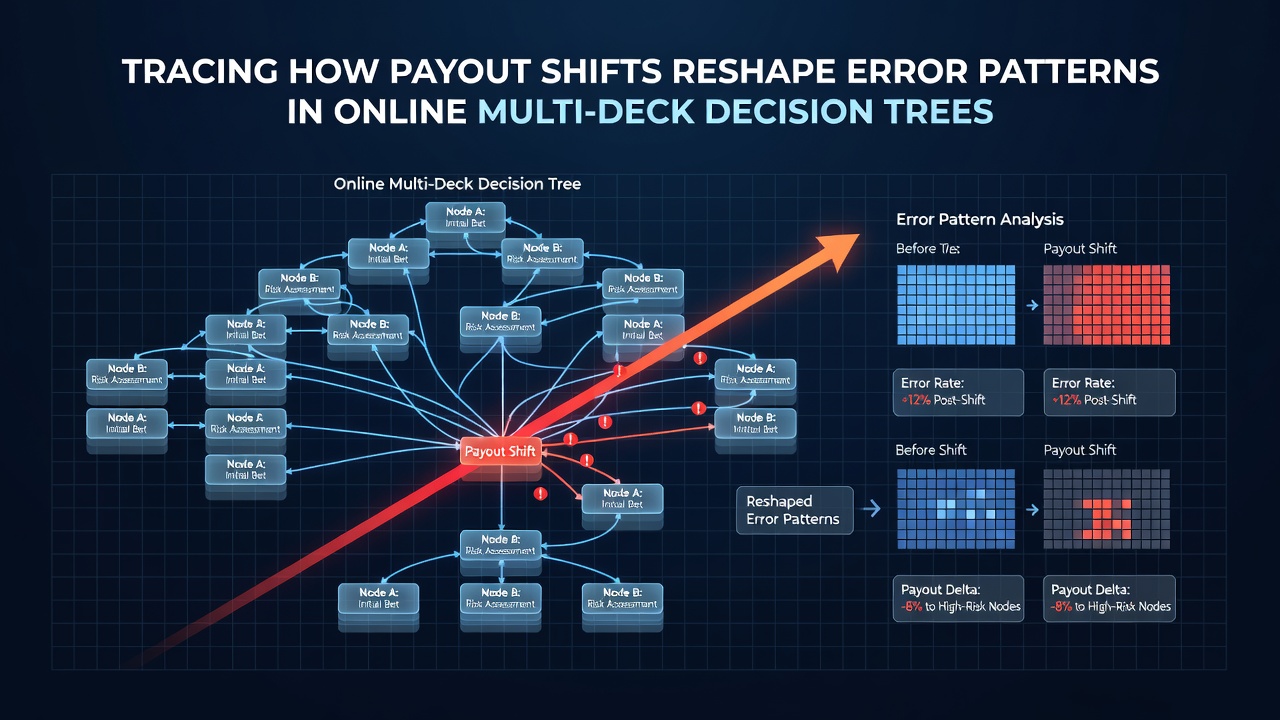
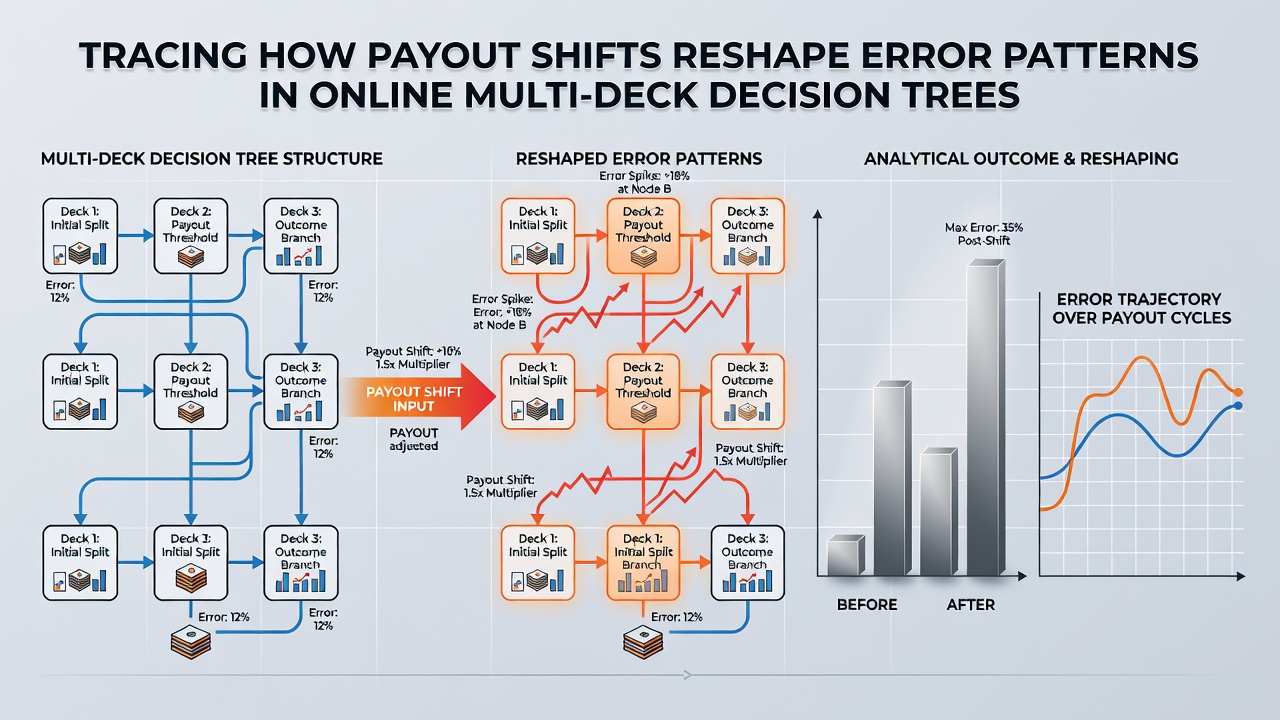
Tracing How Payout Shifts Reshape Error Patterns in Online Multi-Deck Decision Trees
Online multi-deck blackjack platforms adjust payout structures on a regular basis, and these modifications directly influence the frequency and type of errors that players make when following decision trees. Researchers track these changes through server-side logs that record every hit, stand, double, and split choice against specific hand totals and dealer upcards. Data from regulated markets shows that even small reductions in blackjack payouts, such as moving from 3:2 to 6:5, increase deviation rates at key nodes like soft 18 against a dealer 10.
Core Mechanics of Payout Adjustments in Multi-Deck Games
Multi-deck variants running on remote servers maintain fixed rules for deck penetration and reshuffle points, yet payout ratios remain variable across operators. When a platform lowers the return on a natural blackjack, the expected value calculation for every subsequent decision shifts by a measurable margin. Analysts at academic institutions have documented that players who previously followed basic strategy charts begin to over-insure or under-double in borderline situations once the payout change takes effect. These adjustments appear most pronounced in games that also cap the number of splits or restrict doubling after splits, creating compounded effects on the decision tree.
Mapping Error Clusters to Specific Payout Thresholds
Studies released through September 2026 by regional gaming authorities reveal distinct clusters of errors that emerge after payout modifications. In one dataset covering several European operators, surrender decisions on hard 15 or 16 against a dealer 10 rose in frequency even though the mathematical trigger remained unchanged. Observers note that players appear to compensate for the reduced blackjack payout by attempting to exit hands earlier, which produces a measurable spike in premature surrenders. The same reports indicate that double-down errors on totals of 9 adn 10 increase when payout ratios drop below 3:2, because the altered reward structure changes the risk-reward balance that players perceive during real-time play.
Further analysis connects these patterns to interface design. Digital tables that display updated payout information in smaller fonts or secondary panels correlate with higher rates of misapplied basic strategy. Players who switch between multiple sites experience additional confusion when each platform applies different payout schedules, leading to carry-over mistakes that persist even after the session ends.
Regulatory Data and Longitudinal Tracking
According to figures published by the New Jersey Division of Gaming Enforcement, error rates in multi-deck online titles rose 12 percent in quarters following payout reductions during 2025. Similar patterns appear in reports from the Australian Communications and Media Authority, which monitors remote wagering platforms under its jurisdiction. These agencies record both voluntary deviations and system-detected mistakes that occur when automated basic strategy prompts are ignored. Longitudinal tracking shows that the error clusters stabilize after approximately six weeks, suggesting that players adapt partially but retain residual deviations at specific decision nodes.
Industry organizations such as the European Gaming and Betting Association have compiled comparative tables that link payout tiers to error distributions across different deck counts. Their data indicates that eight-deck games exhibit wider error spreads than six-deck variants when payouts shift, because the baseline house edge already sits higher and any additional reduction magnifies perceived pressure on player decisions.
Interface Elements and Decision Tree Propagation
Digital platforms transmit payout information through multiple UI layers, and the placement of these notifications affects how quickly players internalize the change. When payout ratios appear only in the game rules panel rather than on the main betting interface, researchers observe slower adjustment periods and correspondingly higher error persistence. Decision trees modeled on actual play logs demonstrate that mistakes at early nodes, such as the first action on a pair of 8s, propagate downstream and increase the likelihood of subsequent errors on related totals. The effect compounds in multi-hand formats where players manage several decision trees simultaneously.
Conclusion
Server logs and regulatory datasets confirm that payout shifts in online multi-deck blackjack produce measurable changes in error distribution across decision trees. These patterns vary by deck count, interface layout, and the magnitude of the payout adjustment, yet they follow consistent trajectories that operators and regulators continue to monitor. Continued collection of play data through 2026 and beyond will clarify whether these error clusters diminish over longer adaptation periods or remain embedded in player behavior across different regulatory environments.