
Navigating Payout Discrepancies Across Regional Rule Sets and Their Impact on Long-Term Player Bankroll Management in Internet-Based Blackjack
Online blackjack operates under rule sets that shift from one jurisdiction to another, and these differences create measurable payout variations that players must track over extended sessions. Data from regulatory filings show that blackjack payouts range from the traditional 3:2 ratio in some North American markets to 6:5 in others, while European and Asian platforms often standardize on 3:2 yet layer additional constraints such as restricted doubling after split or altered insurance options. Observers note that these payout structures directly influence expected value calculations, and long-term bankroll projections shift accordingly when a player moves between sites licensed in different regions.
Regional Rule Variations and Payout Structures
Platforms licensed in Nevada follow payout ratios documented by the Nevada Gaming Control Board, whereas operators in New Jersey adhere to frameworks established by the Division of Gaming Enforcement that sometimes permit 6:5 on select tables. In contrast, jurisdictions such as Ontario's iGaming framework and certain Australian state licenses maintain 3:2 as standard while imposing stricter limits on side bets that affect overall return percentages. These differences compound when multi-deck games appear across borders, because the number of decks combined with payout ratios alters the house edge by fractions that accumulate across hundreds of hands.
Players who review rule sheets before depositing funds discover that even small adjustments, such as whether surrender is offered or how dealer hits on soft 17, change the frequency of certain outcomes. Research from gaming analytics firms indicates that a shift from 3:2 to 6:5 blackjack payouts increases the house edge by roughly 1.4 percent in otherwise identical multi-deck games, and this margin expands further when regional rules prohibit doubling on certain hands.
Effects on Bankroll Volatility and Session Planning
Bankroll management models rely on accurate expected value inputs, yet regional payout discrepancies introduce variability that standard deviation formulas must accommodate. Data collected across operator reports reveal that sessions conducted under 6:5 rules experience higher short-term swings because winning hands return less relative to the original wager, and this reduced return stretches the number of hands required to recover from downswings. Operators in regions with stricter rules often publish return-to-player percentages that reflect these adjustments, allowing players to recalibrate bet sizing before committing larger portions of their bankroll.
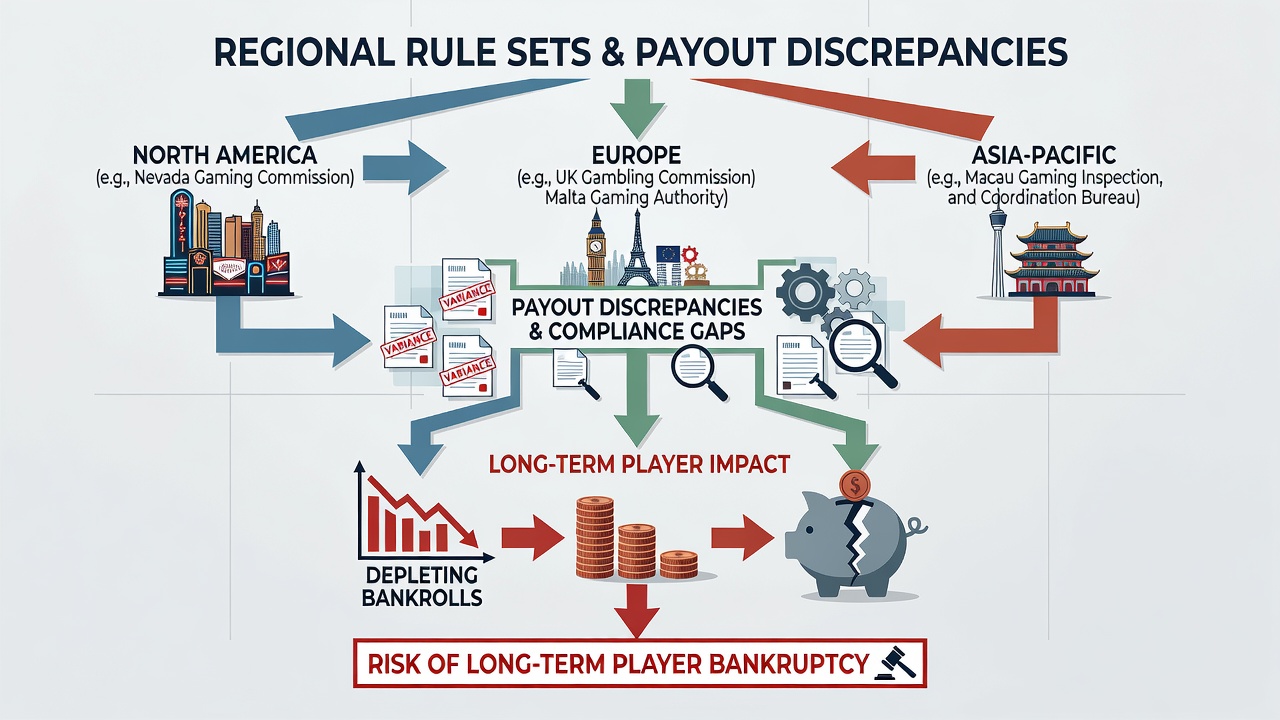
Those who maintain detailed records across multiple platforms find that moving from a 3:2 jurisdiction to a 6:5 jurisdiction requires an increase in reserve funds to maintain the same risk of ruin threshold. Figures released in industry compliance summaries show that players who adjust unit sizes downward by 15 to 20 percent when encountering reduced payouts maintain more consistent session lengths, whereas fixed bet sizes lead to faster depletion under the tighter rules. Regulatory updates scheduled for August 2026 in select North American and European markets are expected to introduce additional disclosure requirements around payout ratios, which may give players clearer data for these recalibrations.
Practical Adjustments Across Jurisdictions
Software tools that aggregate rule sets from various licensed operators enable players to compare expected values before selecting a table, and several platforms now display regional rule summaries directly in the game lobby. Analysts at academic gaming studies centers have documented that players who cross-reference payout tables with their current bankroll size reduce variance exposure by spacing bets according to the specific return percentages of each jurisdiction. When a platform based in one region offers insurance at standard rates while another restricts it, the difference alters the frequency of even-money decisions and requires updated probability tables for accurate bankroll forecasting.
Case examples compiled by compliance researchers demonstrate that consistent tracking of payout discrepancies across three or more regions produces measurable improvements in session endurance, because bet spreads can be scaled to match the house edge present in each rule set. Government reports from multiple licensing bodies confirm that operators must publish these rule variations, and players who consult the disclosures before funding accounts gain access to the raw numbers needed for precise bankroll modeling.
Conclusion
Regional payout discrepancies in internet-based blackjack create distinct expected-value profiles that affect bankroll longevity when players participate across multiple jurisdictions. Accurate tracking of rule differences, combined with adjusted bet sizing and session planning, allows sustained participation even as platforms operate under varying regulatory frameworks. Continued publication of compliance data from licensing authorities supplies the factual inputs required for these ongoing adjustments.