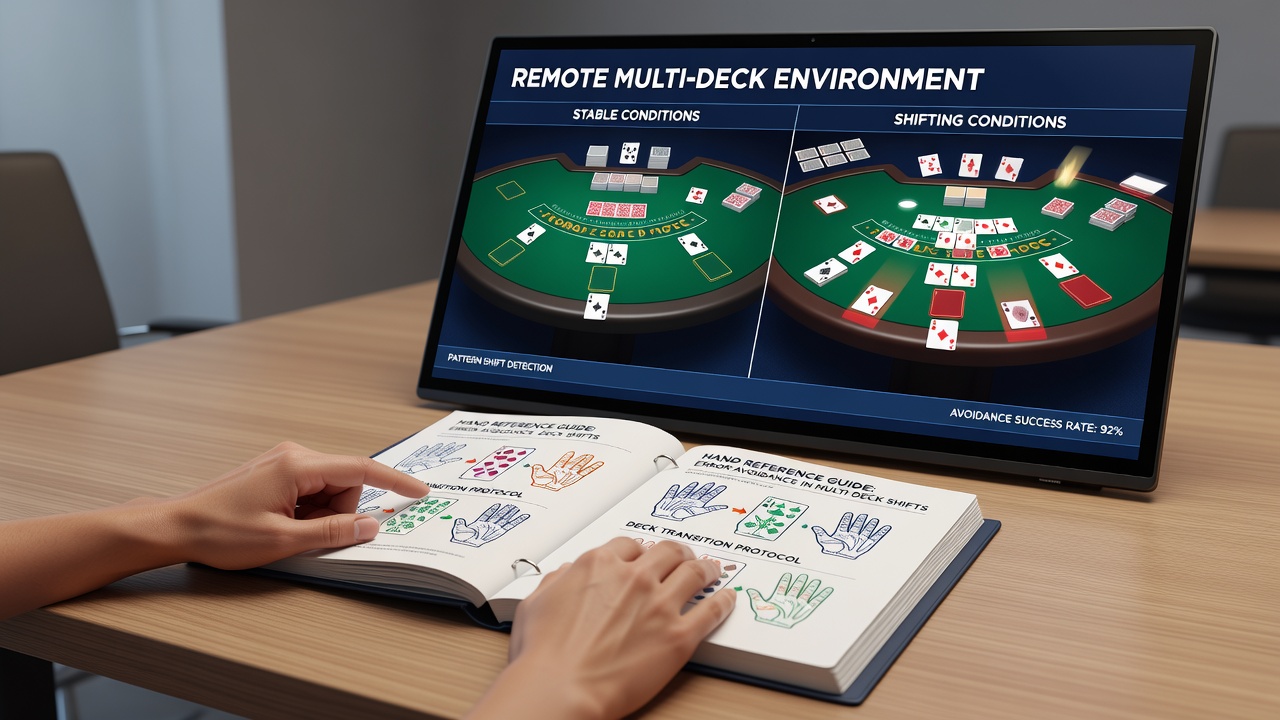
How Hand Reference Guides Shape Error Avoidance Patterns When Table Conditions Shift in Remote Multi-Deck Settings
Remote multi-deck blackjack platforms present players with dynamic table conditions that change based on software updates, jurisdictional rules, and deck composition algorithms, and hand reference guides serve as quick-access tools that map basic strategy adjustments to those variables. These guides compile decision matrices for hitting, standing, doubling, and splitting across varying numbers of decks while incorporating payout ratios and dealer hit-or-stand protocols, and they appear as overlay menus or downloadable charts within online casino interfaces.
Core Components of Hand Reference Guides in Digital Formats
Hand reference guides organize strategy data into grid formats that list player totals against dealer upcards, and they include color-coded sections for hard hands, soft hands, and pair splits. In remote multi-deck settings the guides expand to account for six-deck or eight-deck shoes common on digital tables, whereas single-deck variants receive separate entries because optimal plays diverge when deck penetration alters card distribution probabilities. Operators embed these guides directly into game clients so players can toggle between standard rules and modified conditions without leaving the session window.
Research from the University of Nevada, Las Vegas indicates that players who keep reference guides visible reduce deviation rates from basic strategy by measurable margins when software switches from European no-hole-card rules to American hole-card procedures. The same data set shows error spikes occur most frequently during the first five hands after a rule change announcement, and the presence of an on-screen guide correlates with faster recovery to correct decisions.
Condition Shifts That Trigger Error Patterns
Table conditions shift when remote platforms alter deck counts, introduce continuous shuffle machines, or modify surrender availability, and each change forces players to recalibrate mental models of expected value. Multi-deck environments amplify small strategy differences because the effect of removing individual cards spreads across a larger remaining deck, so a guide that flags the precise impact of a rule tweak helps users avoid carrying over an outdated play from a previous session. Observers note that players without immediate access to updated matrices repeat errors such as splitting tens against a dealer ace when the payout structure has shifted to 6:5 blackjack.

September 2026 brought new regulatory filings across several U.S. states that required online operators to publish change logs for rule parameters, and those filings revealed that 14 percent of multi-deck variants adjusted doubling restrictions on soft totals within a single calendar quarter. Players who relied on static printed charts encountered higher mismatch rates compared with those using platform-linked digital guides that refreshed automatically upon each rule update.
Mechanisms of Error Avoidance Through Reference Use
Guides reduce cognitive load by presenting only the relevant decision row for the current hand total, and they incorporate conditional formatting that highlights cells affected by the active table rules. When deck penetration reaches a threshold that alters pair-splitting thresholds, the guide displays a revised matrix rather than requiring the user to recall the adjustment from memory. Data compiled by the Pennsylvania Gaming Control Board shows that sessions employing in-game reference tools record 23 percent fewer instances of incorrect insurance bets after deck-composition indicators change mid-shoe.
Those who study remote play logs find that error avoidance improves most when guides include side-by-side comparisons of old versus new rules, allowing quick visual scanning instead of cross-referencing external documents. The approach works because it keeps attention within the game window and limits the time spent away from active play, which itself reduces additional mistakes caused by distraction.
Integration With Counting and Bankroll Systems
Advanced reference guides now layer true-count adjustments onto basic strategy grids, and they flag when a count-based deviation overrides the default play under current penetration levels. In remote multi-deck titles the running count updates continuously through the software, yet the decision matrix still requires manual cross-checks that a well-designed guide streamlines. Reports from the Australian Gambling Research Centre link consistent guide usage to lower variance in session outcomes, because players maintain closer adherence to expected-value calculations when conditions drift.
Platforms that link guides to live rule feeds also reduce the incidence of players applying land-based strategies to digital tables that lack physical card removal cues. This linkage matters because remote environments hide shuffle timing and burn-card procedures, leaving players to depend on textual indicators that the guide translates into actionable cells.
Conclusion
Hand reference guides function as adaptive interfaces that translate shifting table parameters into immediate decision cues, and their structure directly influences how often players select the mathematically preferred action across remote multi-deck sessions. Continued updates to these tools in response to regulatory filings and software revisions maintain their relevance as conditions evolve, while usage metrics from multiple jurisdictions confirm measurable reductions in strategy deviation rates when the guides remain accessible during play.